Introduction
Tender documents rarely fail because they are unclear. They fail because they are too clear in too many places at once.
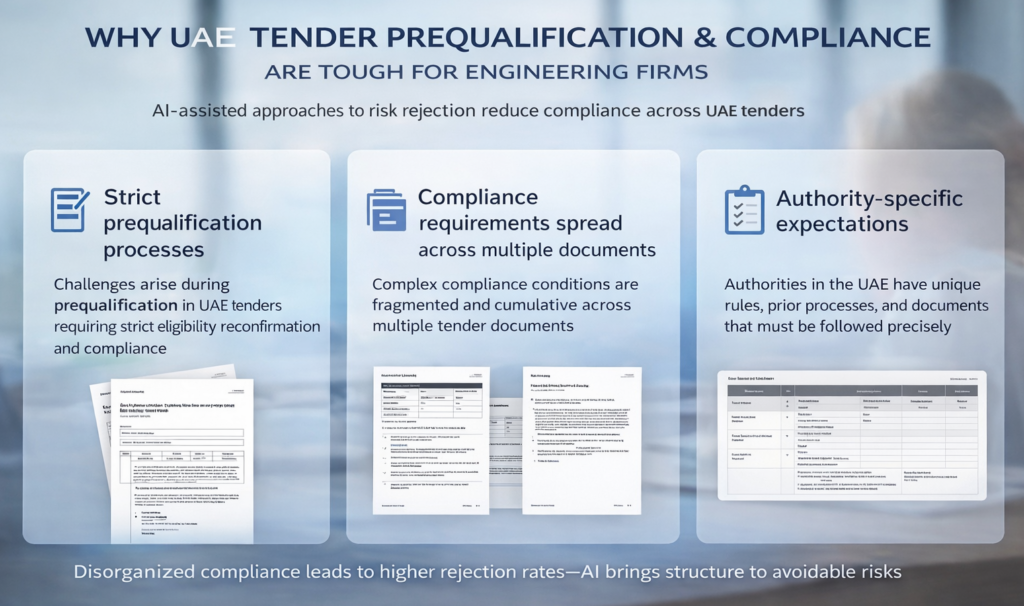
Modern engineering tenders—especially in the USA and UAE—are not single documents. They are collections of instructions, specifications, BOQs, drawings, contract conditions, appendices, and clarifications, all cross-referencing one another. Each section adds obligations, exceptions, and dependencies that are easy to miss when reviewed manually.
Most tender risks do not come from poor pricing or weak technical capability. They come from misunderstood scope, unnoticed BOQ assumptions, and hidden risk clauses that only surface when it is too late to respond properly.
This article explains how AI-assisted tender document analysis helps engineering firms extract scope, BOQs, and risk from complex RFP PDFs—and why this shift matters far more than faster proposal writing.
Why Manual RFP Reading Breaks Down at Scale
Engineering firms have reviewed tender documents manually for decades. Senior engineers, proposal managers, and commercial leads read, highlight, and discuss requirements until a shared understanding is reached. That approach worked when tenders were shorter and less fragmented.
Today, that model is under strain.
Large RFPs routinely exceed several hundred pages. Critical requirements are spread across documents written by different authors, often using inconsistent terminology. Clauses that look harmless in isolation change meaning when read alongside other sections.
Human readers are good at understanding intent, but they are not good at tracking dependencies across dozens of documents simultaneously. Important obligations are missed not because teams are careless, but because the cognitive load has become unreasonable.
Scope Is Rarely Defined in One Place
One of the most common misconceptions in tendering is that “scope” is clearly defined. In reality, scope is usually assembled, not stated.
Parts of the scope appear in:
- Technical specifications
- Employer’s requirements
- BOQs
- Drawings and schedules
- Contract conditions
Each source adds nuance. Some requirements are explicit, others conditional. Some are described as assumptions, others as obligations.
When scope is reconstructed manually, interpretation varies by reader. Engineering teams may focus on drawings, while commercial teams focus on BOQs and contracts. Gaps form silently between these interpretations.
AI-assisted document analysis helps by identifying and grouping scope-related statements across documents, allowing teams to see the full picture of what is being asked, not just isolated fragments.
BOQs Often Hide More Risk Than They Reveal
BOQs are often treated as authoritative. If an item appears in the BOQ, it is assumed to be included. If it does not, it is assumed to be excluded or priced elsewhere.
In practice, BOQs frequently:
- Omit items described in specifications
- Assume a specific design interpretation
- Use descriptions that conflict with drawings
These inconsistencies create risk. Contractors and consultants may price based on one interpretation, while evaluators expect another.
AI-assisted analysis helps cross-reference BOQ items with specifications and drawings, highlighting where assumptions are being made implicitly. This does not eliminate the need for professional judgment, but it makes hidden assumptions visible early, when they can still be addressed.
Risk Lives Between the Lines, Not in Headings
Tender risk is rarely announced clearly. It is embedded in phrasing, conditions, and cross-references.
Examples include:
- Obligations triggered by specific construction methods
- Responsibilities implied rather than stated
- Risk transfer clauses buried in contract schedules
Manual review often prioritizes obvious commercial terms while overlooking technical risk embedded elsewhere. By the time these clauses are discovered, teams are already committed to a pricing and scope position.
AI-assisted tender analysis helps by flagging risk-related language patterns and surfacing clauses that deserve closer human review. It does not decide what is acceptable—but it ensures nothing critical is overlooked.
What AI Actually Does in Tender Document Analysis
There is a misconception that AI “reads” tenders like a human. It does not. Its strength lies elsewhere.
AI excels at:
- Scanning large volumes of text consistently
- Identifying requirement statements
- Grouping related obligations across documents
- Highlighting conflicts and repetitions
This creates structure before interpretation begins.
Platforms such as Ruwaq Design support engineering-led tender teams by transforming unstructured RFP documents into organized requirement sets, allowing engineers, commercial leads, and proposal managers to work from a shared, validated understanding rather than fragmented notes.
Why This Changes How Teams Work Together
When tender requirements are extracted and structured early, team dynamics change.
Instead of debating what the tender “means,” teams discuss:
- Whether they want to accept a requirement
- How to price a specific obligation
- What assumptions must be declared
This shift from interpretation to decision-making improves both speed and quality. It also reduces internal conflict, as disagreements are resolved against the source documents rather than individual opinions.
Early Extraction Enables Better Clarifications
Clarifications are often treated as defensive measures, submitted late and phrased cautiously. In reality, well-timed clarifications are strategic tools.
When requirements are extracted early:
- Ambiguities are identified sooner
- Clarification questions are sharper
- Responses influence pricing and scope decisions meaningfully
AI-supported extraction enables this proactive approach, especially in tenders with strict timelines and limited clarification windows.
Why This Matters More in Engineering-Led Bids
Engineering firms face a unique challenge. Their competitive advantage lies in technical depth, but tenders increasingly reward documentation discipline as much as design quality.
Firms that rely solely on experience and intuition are vulnerable in highly structured evaluation environments. AI-assisted tender document analysis helps engineering firms translate their technical strength into compliant, defensible submissions.
This is not about replacing expertise. It is about protecting it from administrative failure.
Conclusion
Tender documents are not difficult because they are unclear. They are difficult because they are complex, fragmented, and unforgiving of oversight.
AI-assisted extraction of scope, BOQs, and risk from RFP PDFs allows engineering firms to regain control over this complexity. By structuring obligations early, teams reduce hidden risk, improve alignment, and make better-informed decisions throughout the tender process.
For firms competing in demanding markets like the USA and UAE, this capability is no longer a luxury. It is becoming a baseline requirement for consistent, defensible tender performance.